For a long while Sarah Kendall and I talked about starting a poetry group in town with the goal of learning and writing together. We settled on hosting a one-off workshop focused on short form poems and invited people to come and write with us.

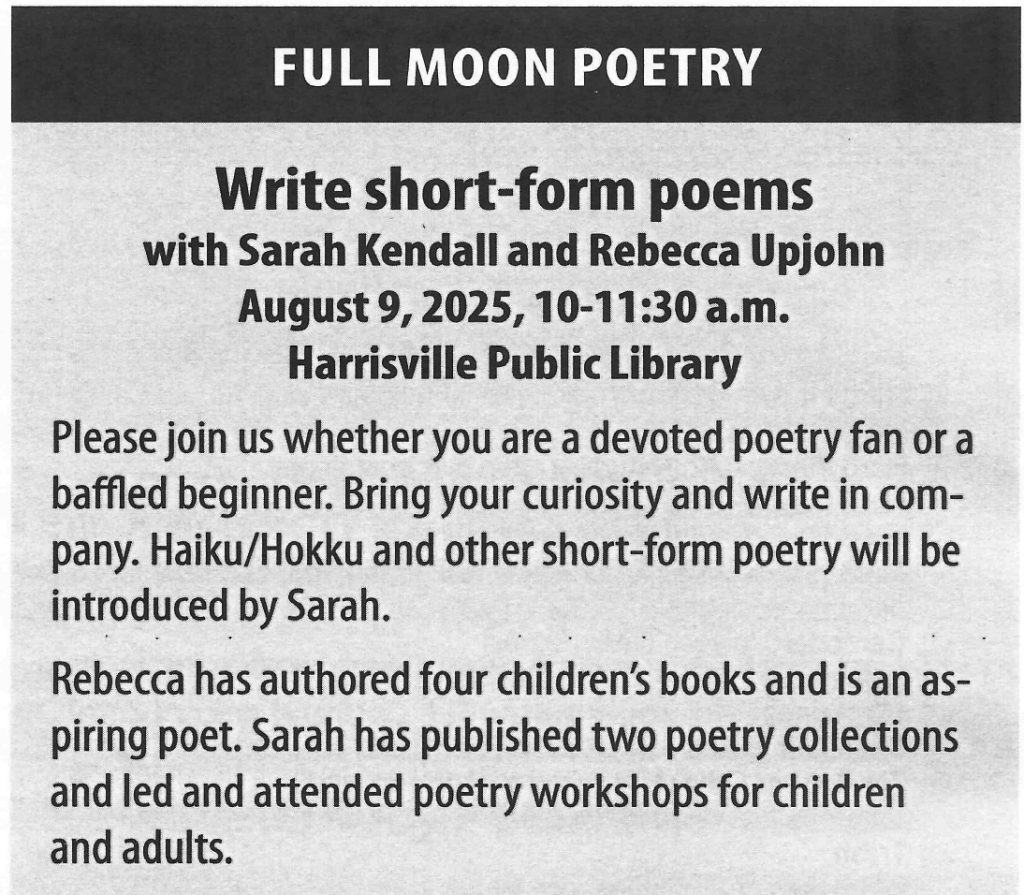
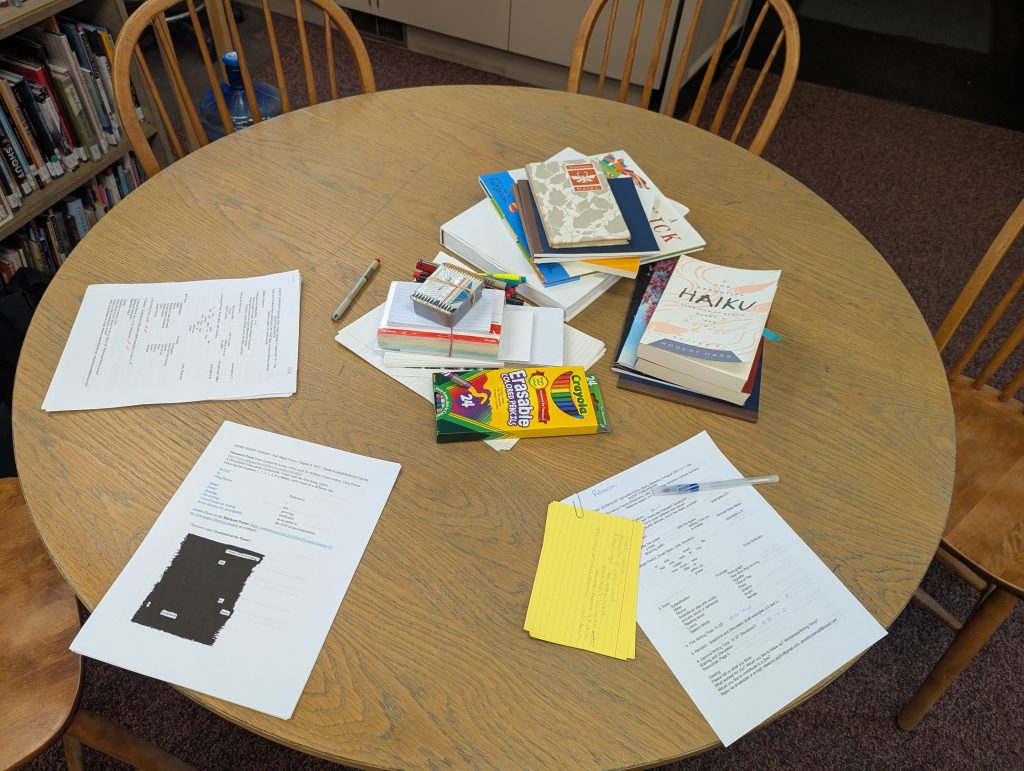
“What brought you here?” we asked in our introduction and “What makes a short form poem different than prose?” And we were off, learning about to how people related to poetry.
Sarah introduced us to hokku, traditionally the opening stanza of renga – a linked verse poem written collaboratively. She told us how these came about (essentially a court game) and its evolution into current haiku. Two of our three participants had some experience with haiku from other workshops. Another talked about how reading a poem multiple times can evoke new meaning.

I shared my current take on the haiku I write: moments of observation in the present, usually with a nature/seasonal reference, bringing together two ideas in a fragment and phrase so they create resonance in the reader (I hope). Typically I write them in fewer than 17-syllables. My learning is evolving.
Draft:
mannered moose plods
through four seasons
while beavers play hockey
tracks across the cove
even beavers play hockey
Final:
beaver tracks
lead to an ice hole-
the missing puck
* see more about this haiku
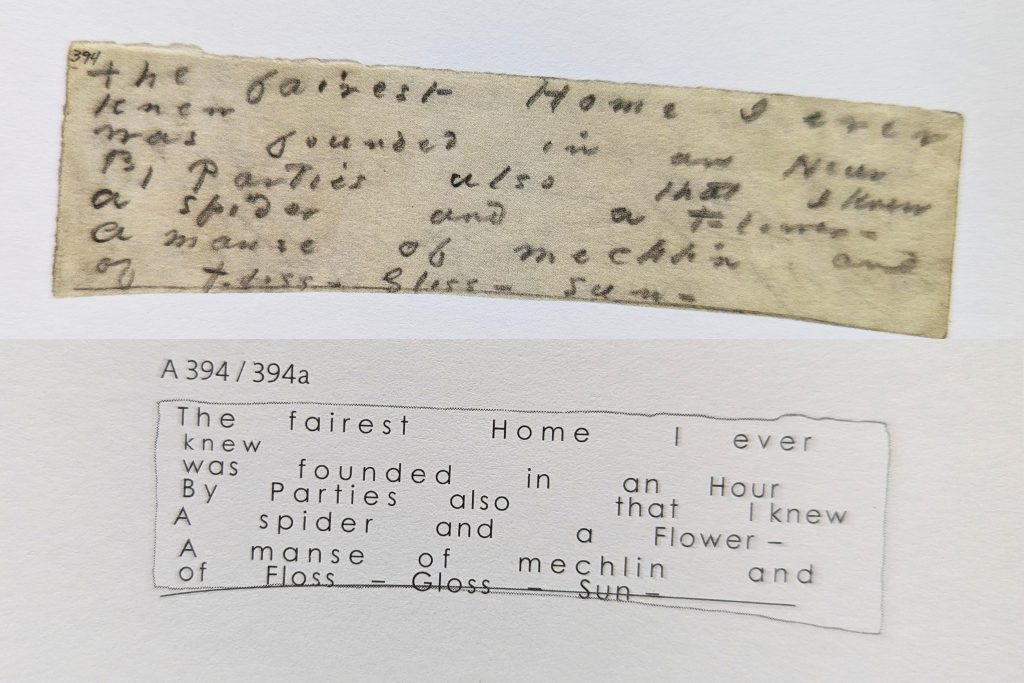
Sarah introduced us to Emily Dickinson’s envelope poems. They are gems. While the rest of us were writing, she looked up the definition of mechlin, from the example above. It is both a Flemish city in Belgium, and during the poet’s lifetime, would have been a recognized term for bobbin lace.

I love that she wrote on envelopes. Writing on scraps of paper, my hand, a napkin can allow me to get the ideas down without making the words too precious. Was that her intention? I’m guessing she used what was at hand. But maybe it shows how her writing was an essential part of her every day. Facing a beautiful blank notebook makes it harder to let the words be bad and to make a mess on the page. And it makes revising even more challenging, but that is my brain on perfectionism.
Sarah’s showed a variety of what she calls Small Takes which she both writes and reads – intentional focus on observed moments and a turn of surprise.
We included a William Carlos Williams poem, “This is Just to Say”; examples of list and acrostic poems. In our handout we also included Fibonacci poems (a form created by Greg Pincus) and blackout/erasure poems (Austin Kleon shares his here).
Sarah shared one of her Small Takes in draft and final forms:
Prompt: SBK listening to Bach’s Goldberg Variations with open doors and windows @8 AM
Draft
bach baffles
the neighborhood
robins with his
lullaby excursions
begs their replies
as the morning
that brightens smiles
Final
bach baffles
neighborhood
robins with
lullaby
excursions
that brighten
morning’s smiles
Then she asked, “What has changed?”
In its final form each line has 3 syllables. Counting syllables is one tool that can provide a useful container for writing and revising the poem, much like the way we are often introduced to writing haiku in the 5-7-5 form of 17 syllables. That idea of form as a container with its boundaries or rules struck me as helpful for also writing more complex poetic forms.
We offered two writing sessions. After the first, early on, the conversation opened around process, inspiration, and drafting versus revision. We shared a list of tools and ideas for prompts.
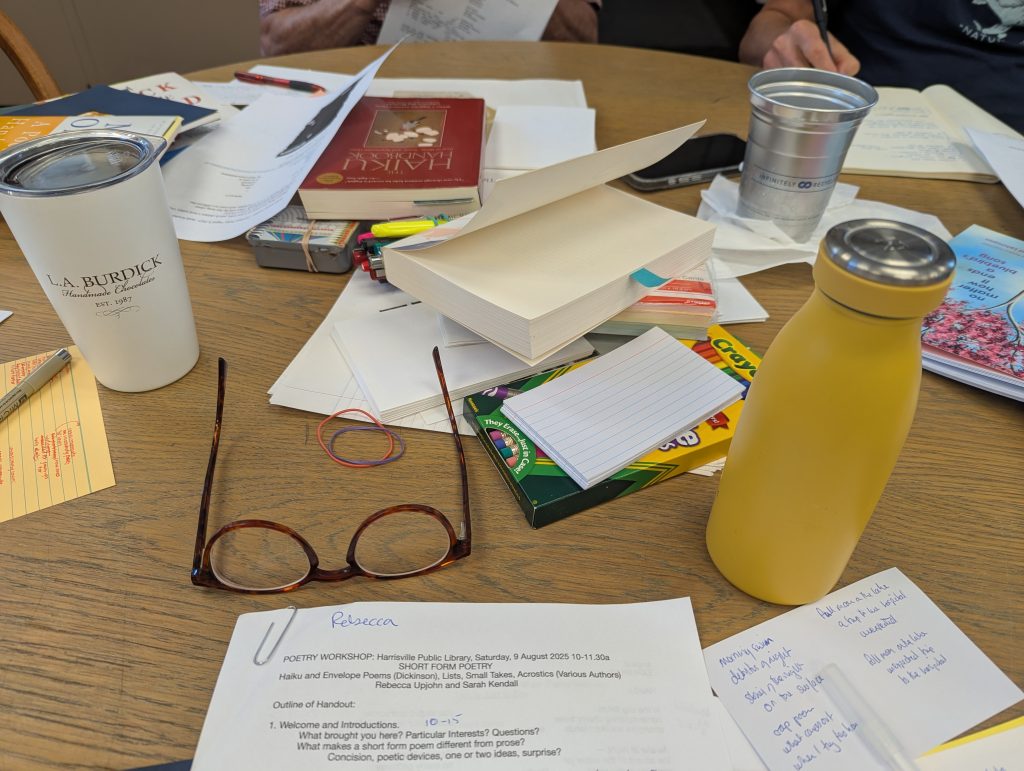

After the second writing session each poet expressed feeling they had a way forward. Each shared something they wrote which spurred more questions about process, more examples and discussion; more what makes a poem?
What I loved about this workshop was setting things in motion and seeing what happened.
The participants all said they’d like to continue. So would we.